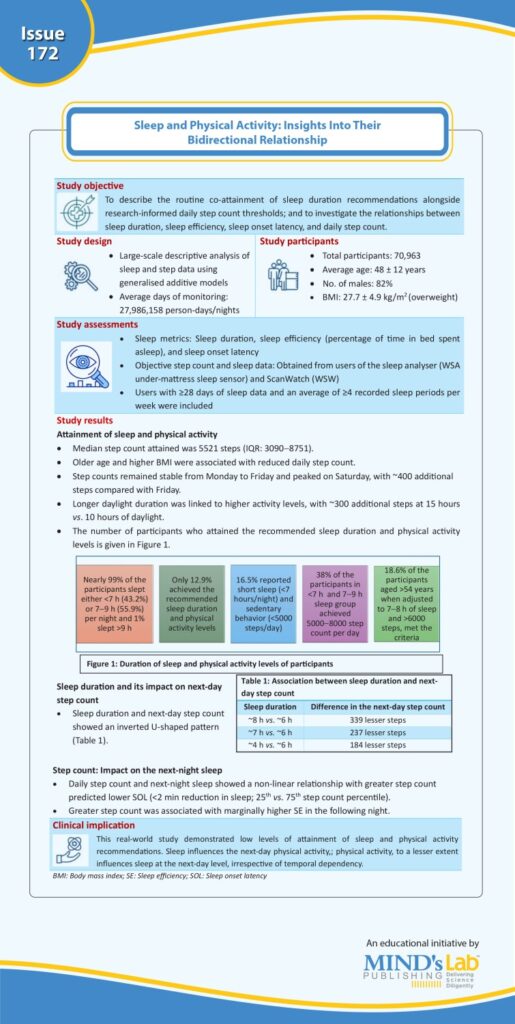

 Both, physical activity and sleep are essential for good health. Recent evidence indicates that achieving 8000 daily steps is an important threshold for adults to lower the risk of multiple adverse health outcomes, including cardiovascular disease and all-cause mortality, while in older adults, approximately 6000 steps may be sufficient. Adequate sleep is an active physiological process essential for life, optimal health, and performance, playing a key role in psychological, neurocognitive, and physiological functions such as learning, memory consolidation, metabolism, and growth and recovery. The National Sleep Foundation recommends 7–9 hours of sleep per night for adults aged 26–64 years and 7–8 hours for adults > 64 years to support optimal health and function.
Bidirectional pathways have been proposed, whereby physical activity supports sleep through improved sleep regularity and reduced inflammation, while insufficient sleep may compromise physical performance and activity due to increased fatigue and reduced growth hormone secretion.
A recent study by Fitton et al., demonstrated that only 12.9% of the people achieve the recommended sleep duration of 7–9 hours per night and >8000 steps per day, with 16.5% having short sleep (<7 hours per night) and sedentary lives (<5000 steps per day). Sleep efficiency predicts next-day step count in a dose-dependent manner. The findings highlight the need to ensure adequate sleep and activity recommendations for good health, and that this is mutually attainable (See graphic for details).